Disclosure: I run a company that sells home testing kits, including for PFAS. Not selling one here. Disclosing anyway.
Here’s a clever piece of science.
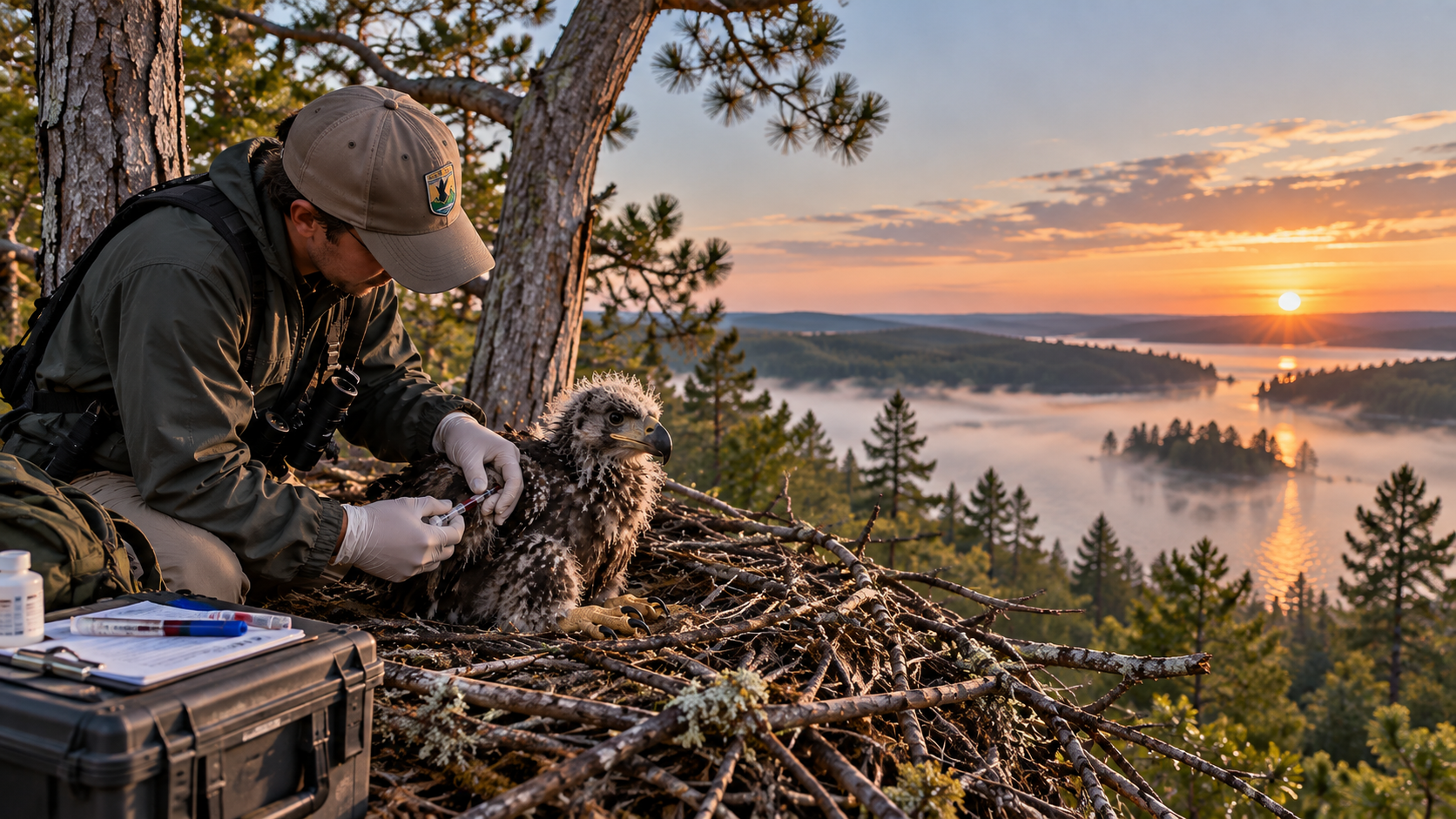
A bald eagle nestling eats only what its parents bring back to the nest. Its parents hunt within roughly five kilometers. So the chick’s blood is a five-kilometer-radius exposure sample with feathers on it. It hasn’t flown anywhere. It hasn’t eaten anything from outside the neighborhood. Whatever’s in its blood came from that patch of ground and water and nothing else.
Researchers from UW–Madison, the Wisconsin DNR, and Chicago’s Field Museum drew blood from 115 nestlings across seven regions of Wisconsin between 2023 and 2025. What they found is the part that should make you rethink what a PFAS result even is.
“PFAS” is not one thing
The PFAS in eagles from Lake Superior and the Apostle Islands looked different from the PFAS in eagles from the Wisconsin River. Not more or less. Different. Different mixes of individual compounds, in different ratios. And those differences pointed to different sources: paper mills in one region, biosolids spreading on farm fields in another, firefighting foam in a third.
This is the concept I wish every client understood. “PFAS” isn’t a chemical. It’s a family of thousands of chemicals that share one feature: a chain of carbon atoms bonded to fluorine. Within that family you’ve got the ones everybody’s heard of, PFOA and PFOS, the old long-chain compounds that were in Teflon and Scotchgard and foam. You’ve got the newer short-chain replacements like GenX and PFBS. You’ve got the precursors, compounds that aren’t PFOA yet but turn into it in the environment. Hundreds of them show up in a typical analytical panel, and a lab report gives you a concentration for each.
The ratios between them are a fingerprint.
How fingerprinting works
Different sources release different mixes, because different products were made with different chemistry.
Aqueous film-forming foam, the firefighting foam used at airports and military bases, was heavy in PFOS and certain precursors. If you see that pattern, you’re looking at a fire training area or a crash site, not a factory.
Paper and textile mills used PFAS for grease and water resistance, and the mixes they discharged look different: different chain lengths, different functional groups.
Biosolids, the treated sewage sludge that gets spread on farm fields as fertilizer, carry whatever went down every drain in the sewershed, which means a broad, messy signature with a lot of the consumer-product compounds.
Landfill leachate has its own look, skewed toward the short-chain compounds that leach more readily and the breakdown products of decades of consumer goods.
So when a lab report comes back, a good analyst doesn’t just look at the total. They look at the pattern. Is PFOS dominant? Is it short-chain heavy? Are there precursors? That pattern gets compared against known source signatures, and what you get is not “there’s PFAS in this well” but “the PFAS in this well looks like foam, not like the landfill.”
Why that sentence is worth a lot of money
“We found PFAS” is a weak statement. Almost everywhere you sample now, you find some. Rain has it. The question in any real dispute is: whose is it?
“We found this pattern of PFAS, and it matches the airport, not the landfill” is a strong statement. It’s the difference between a lawsuit and a shrug, between a responsible party paying for cleanup and a town paying for it. It’s also the difference between a homeowner who knows to look upgradient toward the fire station and one who’s blaming the wrong neighbor.
Groundwater consultants do this with monitoring wells and a lot of statistics. These researchers did it with birds, which is better science than it sounds, because a monitoring well samples one point in the aquifer at one moment, and a nestling integrates a whole food web over a whole season across a whole territory. Same math. Better sampler. Great story.
What this means if you’re holding your own lab report
Most people who test their water get a sheet with twenty or thirty PFAS compounds listed, most of them “ND” (not detected), a handful with numbers, and no idea what to do next. Here’s what to look at.
Find the two or three compounds with the highest concentrations. If PFOS is on top with PFHxS behind it, the fingerprint leans foam, and the question becomes whether there’s an airport, a fire training facility, or a military installation upgradient. On Long Island, that points at Gabreski, at Calverton, at the old Grumman sites. If the short-chain compounds dominate, PFBA, PFBS, PFHxA, that pattern leans toward newer sources and toward leachate, and the question becomes whether there’s a landfill or a wastewater discharge upgradient. If it’s a wide smear of everything at low levels, that’s what regional background looks like now, and it’s less about one source than about all of us.
None of that is a legal conclusion. Fingerprinting in a courtroom takes hundreds of samples and a statistician. But it’s enough to know which direction to look, and which question to ask the water district, which is more than a total-PFAS number will ever tell you.
The caveat
The coverage I’ve seen is from Great Lakes Echo, a regional outlet, and I haven’t confirmed whether this is a peer-reviewed publication or a preliminary release. The concept is well-established; the specific findings need the paper. Also, the piece doesn’t say whether the concentrations are high enough to hurt the eagles, which is a separate question from what the patterns reveal.
What we know
- 115 bald eagle nestlings sampled across seven Wisconsin regions, 2023–2025, by UW–Madison, Wisconsin DNR, and the Field Museum.
- Nestlings’ foraging radius (via parents) is roughly 5 km, giving a localized exposure signal.
- Distinct PFAS congener patterns found by region, consistent with different source types (paper mills, biosolids, firefighting foam).
What we don’t know yet
- Whether the study is peer-reviewed and published. Verify before citing on air.
- Absolute concentrations and whether they exceed any threshold for the birds.
Sources
Great Lakes Echo, September 4, 2026: https://greatlakesecho.org/2026/09/04/bald-eagles-help-scientists-map-forever-chemicals-in-the-great-lakes-region/
Corrections: If we got something wrong, tell us at kelly.sacredintel@gmail.com. We fix errors publicly and note the change here.