I’m going to explain a rule most people have never heard of, because the part of it that’s on the chopping block is the single largest expansion of mandatory ambient air sampling in the country in decades, and if it goes, a specific kind of data goes with it.
What the HON rule is
HON stands for Hazardous Organic NESHAP. NESHAP is the National Emission Standards for Hazardous Air Pollutants, the part of the Clean Air Act that regulates the toxic stuff, as opposed to the smog stuff. The HON covers synthetic organic chemical manufacturing: the petrochemical plants that make the building blocks for plastics, solvents, and everything downstream.
In 2024, EPA finalized a major update. Two big pieces:
Tighter emission controls on specific chemicals, especially ethylene oxide and chloroprene. Ethylene oxide is a sterilant and chemical intermediate that EPA reclassified as a much more potent carcinogen than previously assumed. Chloroprene is used to make neoprene; the plant in Louisiana that makes it has been the center of a decade of community health fights.
Fenceline monitoring for benzene, ethylene dichloride, vinyl chloride, and 1,3-butadiene. That’s the piece I want to explain.
The rule was projected to cut about 6,200 tons of toxic air pollution a year and reduce cancer risk for nearby residents by around 96 percent. It applied to roughly 220 facilities. Since 2025, more than 70 of them have received temporary exemptions. Now EPA has signaled it’ll propose a rewrite this fall that significantly scales the rule back.
What fenceline monitoring is
Traditionally, air pollution from a plant is regulated at the stack. The plant measures what comes out of its emission points, reports it, and stays under the permitted amount. That works for the sources the plant knows about.
It doesn’t work for everything else. Leaking valves. Flanges. Pump seals. Storage tank breathing. Loading operations. Spills. The thousands of small sources that don’t have a stack and don’t get measured. Collectively they can be a big share of what actually leaves the property, and nobody’s counting.
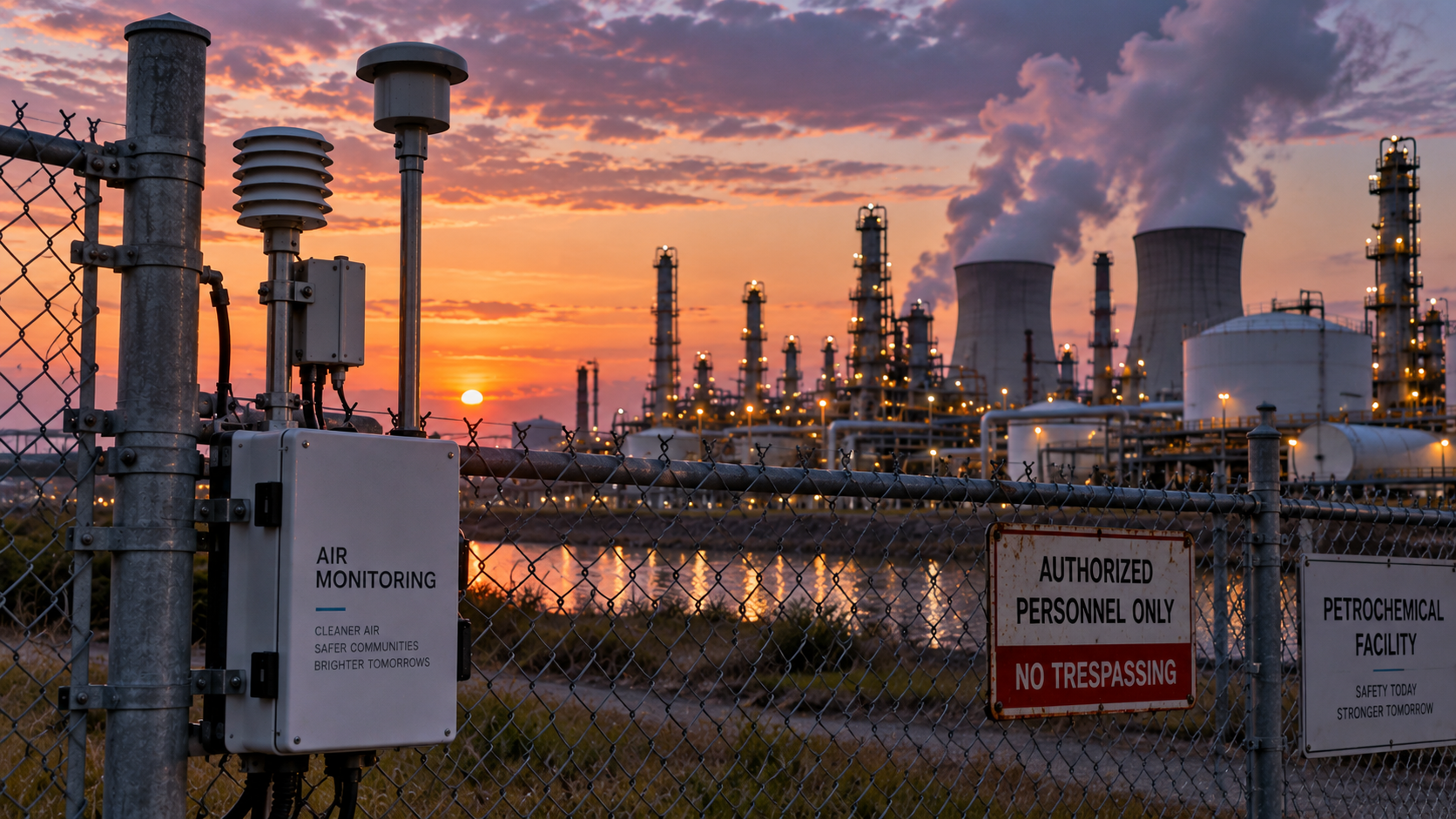
Fenceline monitoring flips the approach. Instead of measuring at the source, you measure at the property line. Passive samplers, small tubes that absorb the target chemicals over a two-week period, are placed around the perimeter. They get collected, analyzed, and the results tell you what’s actually crossing the fence, regardless of where inside the plant it came from.
The concept was pioneered under the refinery rule about a decade ago for benzene, and it worked: refineries that found high fenceline readings went looking for the leaks and found them. The HON rule extended it to four chemicals at chemical plants.
Why it’s the provision to watch
The emission limits get the headlines. The monitoring is the part that matters, for one reason: it’s the only data that exists about what’s actually in the air at the fence.
Without fenceline monitoring, a community next to a chemical plant has stack reports (which measure what the plant chose to measure) and complaints (which measure what people smelled). That’s it. There’s no independent, continuous, quantitative record of what’s crossing the property line. Which means that when someone in that community gets sick, there’s no exposure data to connect it to.
With fenceline monitoring, there’s a two-week-by-two-week record, at multiple points around the perimeter, of benzene and vinyl chloride and butadiene concentrations, published. That record is what a community uses to prove exposure. It’s what a plant uses to find its own leaks. It’s what a regulator uses to enforce. And it’s what a plaintiff’s expert uses in the courtroom, which is a big part of why industry fights it.
Roll back the emission limits and the air gets somewhat dirtier. Roll back the monitoring and nobody can prove how dirty it got. Those are different losses, and the second one is quieter and lasts longer.
How the monitoring actually works, for the curious
The samplers are about the size of a shotgun shell, hung on a post at chest height at points around the perimeter, typically a dozen or more depending on the fence length. Each holds a sorbent that passively absorbs the target compounds from the air over a 14-day period. No pump, no power. After two weeks the tubes are swapped, sent to a lab, and analyzed by gas chromatography. The result is a two-week average concentration at each point.
The rule sets an action level for each chemical. If the difference between the highest and lowest reading around the fence exceeds it (that’s how the method separates the plant’s contribution from regional background), the facility has to conduct a root-cause analysis and fix the source. The data gets reported to EPA and posted publicly. That last part is the part that changes behavior.
What I’m watching for
The proposal, when it drops this fall. Specifically: does it keep the fenceline requirement, weaken it, or remove it? Does it change the action level, the concentration that triggers a plant to go find the source? Does it reduce the number of chemicals monitored? Does it extend the exemptions?
I’m not going to tell you whether the rollback is good policy. That’s a political question and I don’t do those here. I’ll tell you what the data is and what it’s for, and you can decide whether losing it matters to you. If you live within a couple miles of one of the 220 plants, it probably does.
What we know
- The 2024 HON rule required emission controls for ethylene oxide and chloroprene and fenceline monitoring for benzene, ethylene dichloride, vinyl chloride, and 1,3-butadiene at ~220 facilities.
- Projected impact: ~6,200 tons/year toxic air pollution reduction, ~96% cancer risk reduction for nearby residents.
- 70+ facilities have received temporary exemptions since 2025.
- EPA has signaled a proposal to scale back the rule in fall 2026.
What we don’t know yet
- What the proposal will actually say about fenceline monitoring.
- Which facilities hold exemptions and on what basis.
Sources
Grist, September 6, 2026: https://grist.org/regulation/a-hard-won-rule-to-cut-chemical-plant-pollution-is-being-unraveled/
Corrections: If we got something wrong, tell us at kelly.sacredintel@gmail.com. We fix errors publicly and note the change here.