Most people will never hear of 1,2-dichloropropane, and that’s fine. It’s a chlorinated solvent and chemical intermediate. It’s used in making other chemicals, it shows up in some industrial processes, and it is not under your kitchen sink. It doesn’t make headlines.
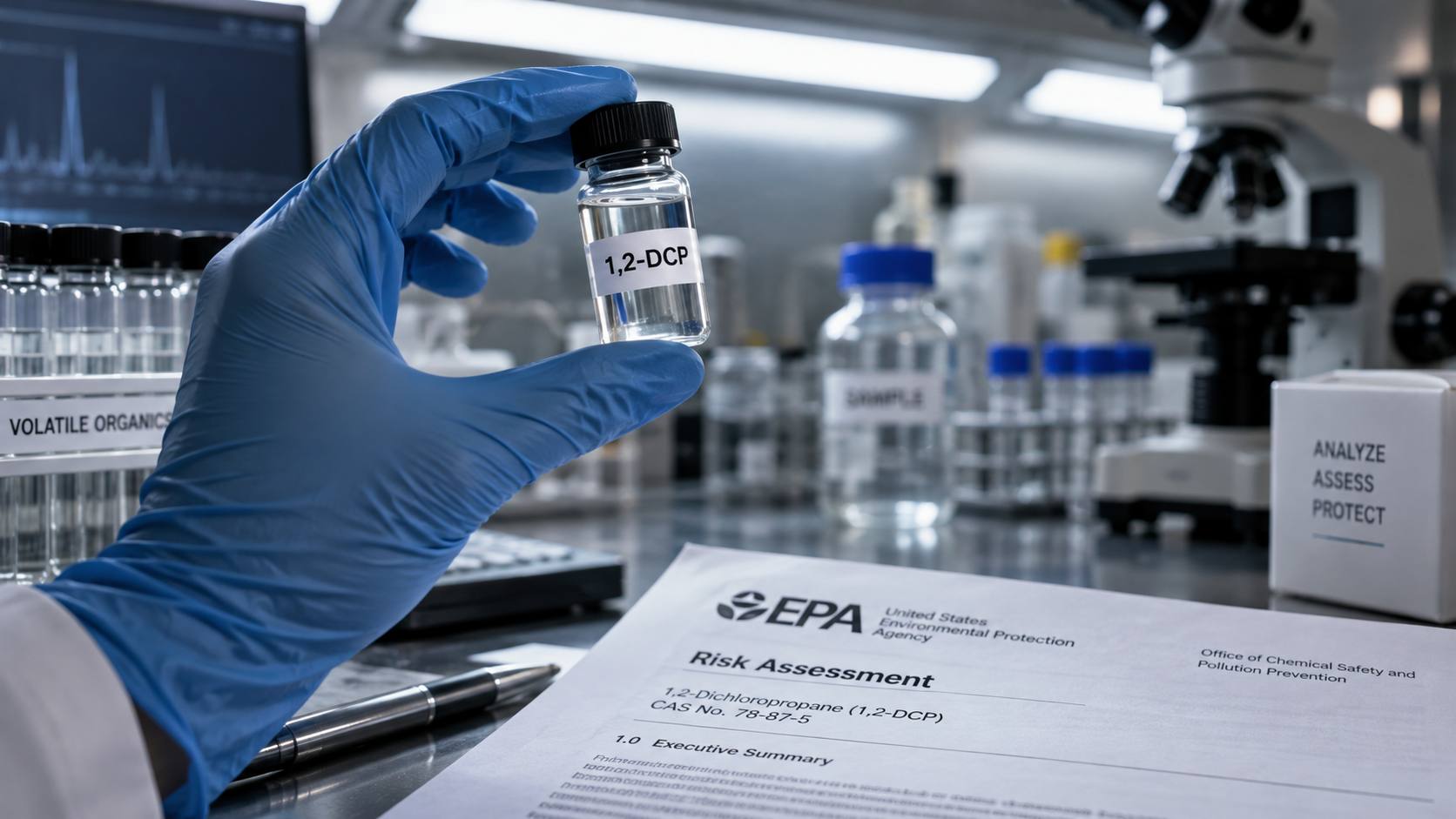
But on September 4, EPA published a draft risk evaluation under the Toxic Substances Control Act saying the chemical presents an unreasonable risk to human health. And the reason isn’t the general public. It’s workers. Specifically, it’s a set of worker scenarios that includes one word that should get the attention of everyone in my line of work.
How TSCA works, in ninety seconds
EPA picks a chemical. It looks at every “condition of use,” which is regulatory for every way the stuff gets made, moved, used, and thrown away. For each one, it estimates who gets exposed, how much, and by what route. Then it compares those exposures to the levels that cause harm. If the gap is too small, the finding is “unreasonable risk.”
That finding is not a rule. It’s the math. The rule comes next, under Section 6 of the statute, and it can be anything from a required engineering control to a PPE mandate to a ban on a specific use. But the sequence matters: once “unreasonable risk” is on paper, a Section 6 rule follows. It’s not optional. The statute requires EPA to address the risk it found.
So a draft evaluation is the moment to pay attention, because it’s the moment the exposure assumptions are still open for argument.
What the draft says
EPA evaluated inhalation and dermal exposure for workers and for occupational non-users. That second category is worth translating: it’s the person who doesn’t handle the chemical but works in the same building. The forklift driver. The office staff. The guy at the next station.
The scenarios assessed include:
Processing as a reactant (using it to make something else)
Commercial laboratory use
Disposal to incineration, landfill, and wastewater treatment
Remediation
That last one is the story.
Why “remediation” matters
When EPA lists remediation as its own exposure scenario, it’s saying something that sounds obvious and isn’t treated that way in practice: the crew hired to clean up a chemical is a population at risk from that chemical.
A lot of exposure thinking treats cleanup as the end of the risk. The spill happened, the release happened, now we remediate, and remediation is the solution. But remediation is work. It’s excavation, it’s pumping, it’s handling contaminated soil and water and equipment, and the people doing it are standing closer to the source than anyone else ever will. This draft puts them inside the risk determination, which means any Section 6 rule that follows can reach them directly: required respiratory protection, required monitoring, required work practices, on any job where this chemical is present.
If you write exposure assessments or respiratory protection programs for crews that could touch this stuff, the controls you’ll eventually be required to have are being decided right now. You have until November 3 to say something about it. Comment on behalf of your clients if the scenarios don’t match how the work is actually done. That’s what the comment period is for, and industry uses it. Safety people mostly don’t.
The honest caveat
It’s a draft. Draft evaluations get revised, sometimes substantially, and the specific numbers EPA relied on (exposure concentrations, margins of exposure, the points of departure for health effects) are in the technical support documents, not in the Federal Register notice. Read those before you cite a figure. But the direction of travel on TSCA evaluations has been pretty consistent for years: once “unreasonable risk” shows up in a draft, it rarely disappears in the final.
What we know
- EPA published the draft TSCA risk evaluation for 1,2-dichloropropane on September 4, 2026, with a preliminary unreasonable-risk determination for human health.
- Occupational scenarios evaluated include reactant processing, commercial lab use, disposal (incineration, landfill, wastewater), and remediation.
- Inhalation and dermal routes assessed for workers and occupational non-users.
- Comments due November 3, 2026.
What we don’t know yet
- What the final determination will say.
- Which uses will face restrictions in a Section 6 rule, and on what timeline.
- The specific exposure concentrations and margins of exposure EPA relied on.
Key facts
- Federal Register document 2026-18117, published September 4, 2026.
- Comment deadline: November 3, 2026.
Sources
Federal Register, 1,2-Dichloropropane Draft Risk Evaluation Under TSCA: https://www.federalregister.gov/documents/2026/09/04/2026-18117/12-dichloropropane-draft-risk-evaluation-under-the-toxic-substances-control-act-tsca-notice-of
Corrections: If we got something wrong, tell us at kelly.sacredintel@gmail.com. We fix errors publicly and note the change here.