This is the one I’d put in every OSHA 10 and 30 class I teach from now on.
NIOSH ran a pilot study. They bought counterfeit or misrepresented P100 filters and chemical cartridges, the kind people order online because they’re cheaper and ship faster, and tested them against the actual NIOSH performance requirements. Nearly all of them failed. NIOSH also reports it’s had more than 1,000 online listings for counterfeit or misrepresented respirators taken down since January 2025, and it keeps publishing case reports through its National Personal Protective Technology Laboratory naming the specific products that flunked.
The thing everybody misses
A fit test checks the seal between the mask and your face. Qualitative, with the sweet or bitter spray under a hood, or quantitative, with a machine counting particles inside and outside the mask. Either way, it’s testing one thing: does air get in around the edges.
It does not check whether the cartridge screwed into the mask does anything.
You can pass a quantitative fit test with a perfect seal, a fit factor of 500, and be breathing straight through a filter that’s mostly marketing. The fit test says the door is closed. It says nothing about whether there’s a wall. And a P100 is supposed to be a very good wall: 99.97 percent of particles captured, oil-proof. A counterfeit might do a fraction of that, and it looks identical from the outside.
So a respiratory protection program with everything OSHA 1910.134 requires (written program, medical evaluation, fit testing, training, cartridge change schedule) can still be protecting exactly nobody if procurement bought the cartridges from a marketplace seller with a fake approval label. Compliant and useless at the same time. That’s the failure mode.
How to tell what you’ve got
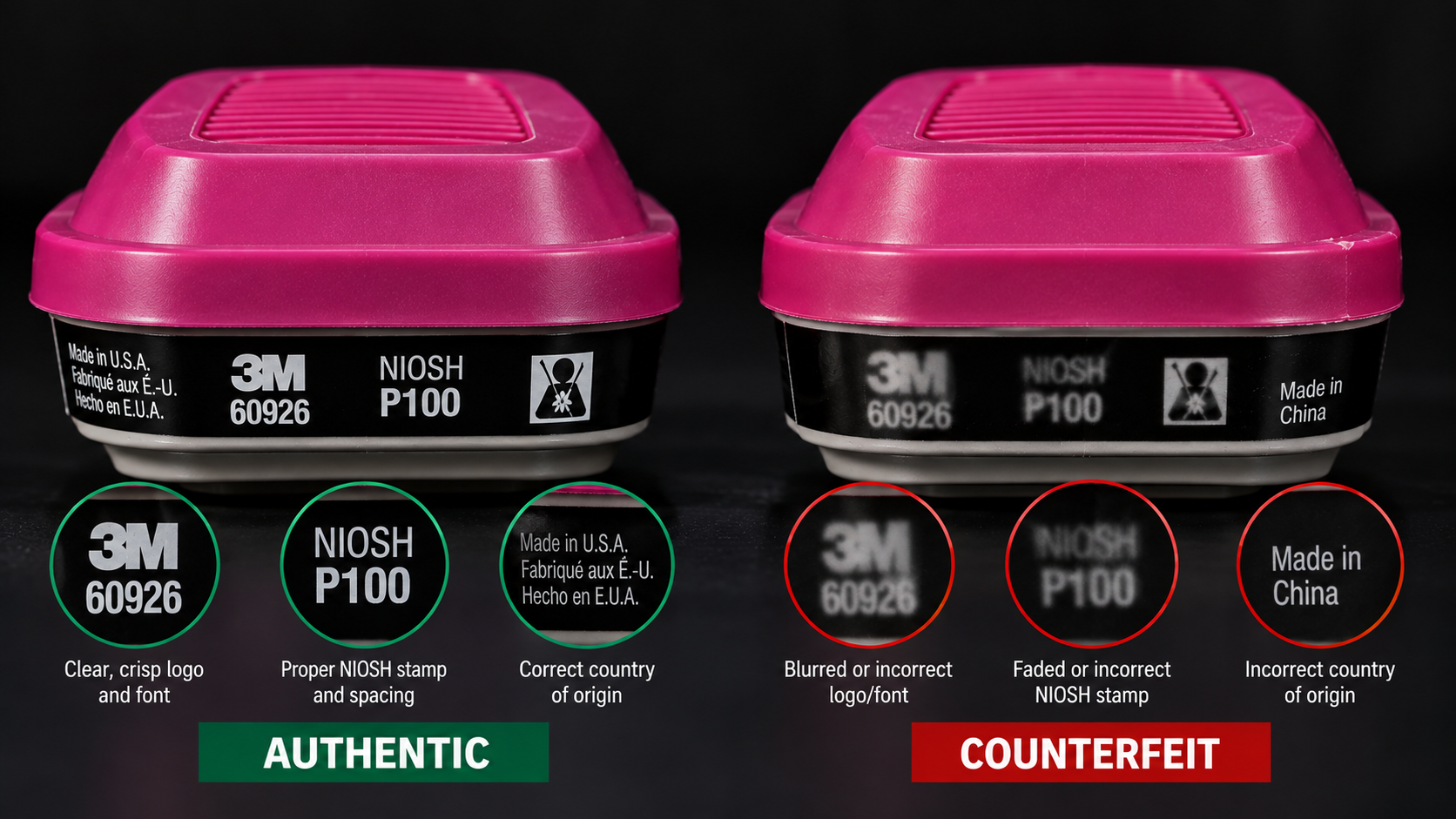
Every NIOSH-approved respirator component carries a TC approval number. TC-84A-xxxx for particulate filters, TC-23C-xxxx for chemical cartridges, and so on. The number is printed on the filter, the cartridge, or the packaging, along with the NIOSH name and the manufacturer.
That number can be checked against the NIOSH Certified Equipment List, which is a public, searchable database. Type in the number. If it comes up, and the manufacturer and product match what you’re holding, it’s legitimate. If it doesn’t come up, or it comes up as a different product, it’s not a cartridge. It’s a decoration.
Other red flags NIOSH has published: NIOSH logo but no TC number. TC number but wrong format. Spelling errors on the packaging. “N95” printed on ear-loop masks (NIOSH doesn’t approve ear-loop designs). Prices that are way under what the legitimate product costs. A seller you’ve never heard of.
The fix, which is boring, which is why nobody does it
Add a procurement verification step to the written respiratory protection program. Three lines:
Respirators, filters, and cartridges are purchased only from the manufacturer or an authorized distributor. Keep a list of approved vendors in the program.
On receipt, the TC approval number on the product is checked against the NIOSH Certified Equipment List. Log the check: date, product, TC number, who checked.
Any product that fails the check is quarantined, not issued, and reported to NIOSH.
Ten minutes per order. Write it into the program so it’s someone’s job, not a good idea that everyone assumes someone else is handling.
For trainers
If you teach OSHA outreach or run respirator training, this is a five-minute add to the PPE module. Show the class a TC number. Show them the CEL search page. Have them look one up on their phones. The point isn’t that everyone becomes a procurement expert. The point is that the next time a foreman gets handed a box of cartridges from an unfamiliar brand, somebody in the crew knows enough to ask.
And check your own kit. I did.
What we know
- NIOSH pilot study: nearly all counterfeit/misrepresented P100 filters and chemical cartridges tested failed NIOSH performance requirements. Reported in NIOSH eNews, September 2026.
- 1,000+ online listings for counterfeit/misrepresented respirators removed since January 2025.
- NIOSH continues to publish NPPTL case reports identifying specific failing products.
What we don’t know yet
- Sample size and specific products in the pilot; see the NPPTL case reports.
- How much counterfeit product is currently in circulation on jobsites.
Sources
Corrections: If we got something wrong, tell us at kelly.sacredintel@gmail.com. We fix errors publicly and note the change here.