I’m going to try to write this one without the temperature going up, and I’m going to fail a little, so bear with me.
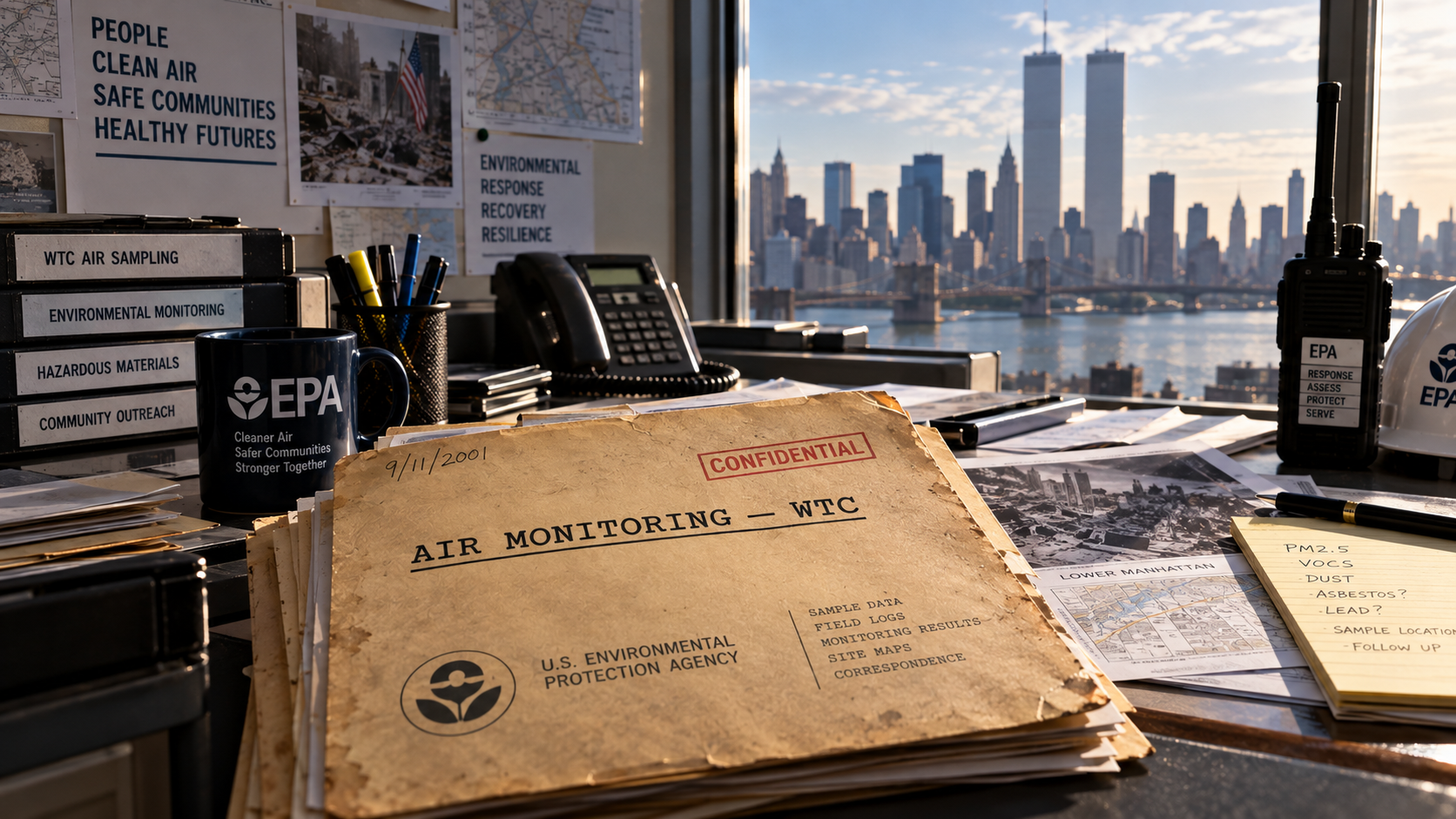
On September 8, the city released more than 170,000 pages of internal records on air quality in lower Manhattan after September 11, 2001. The release answers a 28-part Freedom of Information Law request filed in 2023. It took three years and a change of administration to get the documents out. Now they’re out, and NY1, NPR, and Al Jazeera have all been through enough of them to tell the same story.
The story is this. City officials documented elevated asbestos in the dust that coated lower Manhattan. They discussed it internally. They anticipated being sued over it. And they told the public the air was safe and that residents should clean their own apartments with wet mops and rags.
What’s in the documents
Two memos are getting the most attention, and they deserve it.
The first is from October 2001, a month after the attacks, and it’s being called the Harding Memo after its author. In it, city officials are already anticipating litigation over “toxic exposure.” That’s the phrase. One month in, with the pile still burning, somebody in city government wrote down that they expected to be sued over what people were breathing.
The second is an internal memo from adviser Ester Fuchs acknowledging “at least a low level of asbestos in the dust in many buildings in lower Manhattan.” Read that alongside what residents were being told at the time, which was that the air was safe, that the dust was mostly pulverized concrete and gypsum, and that the right thing to do was go home, open the windows, and clean up.
Wet mops. Rags. For dust that the city’s own memo said contained asbestos.
Why the wet-mop guidance is the worst remediation advice in American history
I want to be precise about why this is so bad, because “they told people to clean it themselves” doesn’t fully land unless you know what asbestos abatement actually involves.
Asbestos fibers are dangerous when they’re airborne and inhaled. The whole discipline of abatement exists to keep them from becoming airborne: negative-pressure containment so fibers can’t escape the work area, HEPA-filtered air handling, wetting methods that keep fibers bound, workers in full-face respirators and disposable suits, air clearance sampling before anyone’s allowed back in without protection. Every one of those steps exists because once fibers are in the air, they stay there, and the dose you get is the dose you breathe.
A wet mop on a fine dust deposit does two things. It picks some up. And it stirs the rest into the air, where it stays suspended, where the person mopping breathes it, where their kids breathe it, where it settles into the carpet and the couch and the HVAC ducts to be re-suspended every time someone walks through the room for the next decade. Wet-mopping asbestos-containing dust in an occupied apartment, with no respirator, no containment, and no clearance, is not cleanup. It’s a dispersion method with a mop attached.
The city knew what asbestos was. The city had an entire regulatory apparatus for asbestos. The Department of Environmental Protection issues abatement permits. Anyone who’s ever renovated a pre-1980 building in this city knows the rules, because the rules are strict and enforced. And the same city told 400,000 people to handle it with a Swiffer.
The numbers
About 400,000 people were exposed, per the reporting. Residents, workers, first responders, students, people who went back to their offices when they were told it was fine. As of the coverage this week, roughly 4,343 have died of 9/11-related illness. That’s more than died on the day itself.
I’ll say the thing plainly: not every one of those deaths is attributable to the wet-mop guidance or to the “air is safe” messaging. Many of the sickest were responders on the pile, and their exposure was going to be catastrophic regardless of what anyone said at a press conference. But there is a population of residents and downtown workers whose exposure was shaped, directly, by being told to go back in and clean up. We’ll never know exactly how many. That’s the point. Nobody was counting, because officially there was nothing to count.
The industrial hygiene lesson, and it’s not the one people think
Here’s where I have to put my own field on the table.
The failure at Ground Zero was not a sampling failure. People sampled. EPA sampled, the city sampled, independent researchers sampled. The data existed. The Fuchs memo is proof that it existed and was read.
The failure was in the gap between what the data showed and what the public was told. And that gap opened because exposure assessment, clearance criteria, and risk communication were treated as three separate jobs done by three separate groups of people with three separate sets of incentives. The people with the data weren’t the people writing the press releases. The people writing the press releases had a memo in the file anticipating litigation.
In my world, we have a phrase for keeping a thing intact from the moment it’s collected to the moment it’s used: chain of custody. We apply it to samples. We should apply it to the whole process. The number that comes off the sampling pump should be the same number that sets the clearance criterion should be the same number that goes in the notice to residents. When those three can diverge, they will, and when they diverge, the direction is always the same: the public gets the reassuring version.
Every argument I’ve ever made to a client about documenting results, defining clearance before you start, and refusing to let “no detect at the perimeter” become “it’s safe to go back in” now has 170,000 pages of primary-source backing. I didn’t want it this way. Here it is anyway.
There’s a second, smaller lesson buried in this, and it’s about who gets to write the guidance. The wet-mop instruction didn’t come from an industrial hygienist. No IH would have written it. It came from the people whose job was to get the city functioning again, and functioning meant people back in their apartments. That’s not a villain motive. It’s a competing priority. The lesson is that the person setting the clearance criterion can’t be the person who needs the answer to be “clear.”
What I’m not going to do
I’m not going to name the officials and tell you what I think of them. Some of them are dead. Some of them will testify. The documents will do that work better than I can, and the lawyers will do the rest.
I’m not going to turn this into a story about which mayor released the records or which mayor sat on them. That’s a politics story and it’s not mine.
What I’m going to do is put this episode on the Disaster Files list, walk a guest through what was measured versus what was said, and end on the wet mop. Because 25 years later, the pattern hasn’t gone anywhere. East Palestine had a version of it. Flint had a version of it. The next one will too. The only defense is a discipline that refuses to let the data and the message come apart.
What we know
- NYC released 170,000+ pages of internal post-9/11 air quality records on September 8, 2026, in response to a 28-part FOIL request filed in 2023.
- The October 2001 “Harding Memo” shows officials anticipating litigation over “toxic exposure.”
- An internal memo from adviser Ester Fuchs acknowledged “at least a low level of asbestos in the dust in many buildings in lower Manhattan.”
- Residents were told the air was safe and instructed to clean apartments with wet mops and rags.
- Approximately 400,000 people were exposed; roughly 4,343 have died of 9/11-related illness per current reporting.
What we don’t know yet
- The full contents of the 170,000 pages; reporters have been through a fraction.
- What the sampling data in the records actually shows, concentration by concentration, versus what was summarized in memos.
- What the World Trade Center Health Program and pending litigation will do with the release.
Key facts
- Release date: September 8, 2026. Source: NY1, NPR, Al Jazeera.
- Documents: 170,000+ pages. Source: NY1.
- Exposed population: ~400,000. Deaths from related illness: ~4,343. Source: reporting as of September 9, 2026; verify against WTC Health Program data before citing on air.
Sources
Corrections: If we got something wrong, tell us at kelly.sacredintel@gmail.com. We fix errors publicly and note the change here.